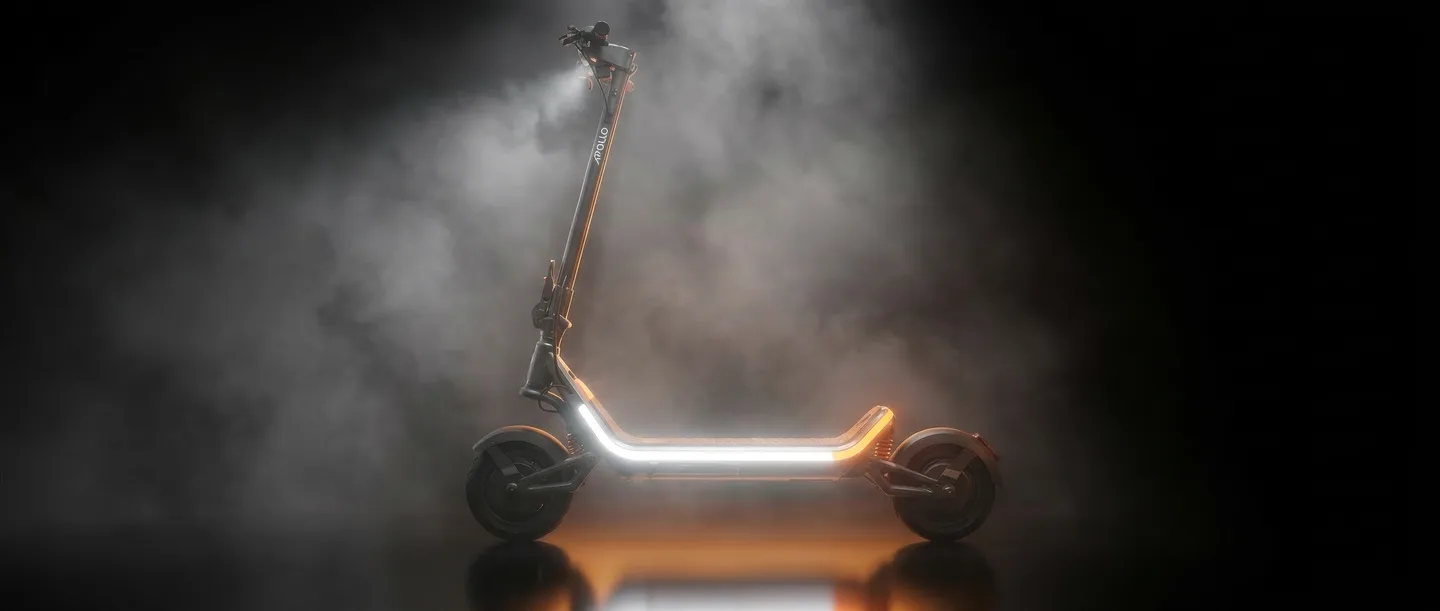
Apollo City 2.0 review: paying $1,299 for the ride, not the numbers
The City 2.0 is heavier than its rivals, not appreciably faster, and the nicest thing to ride in its class by a distance nobody expected.
The verdict
Apollo rebuilt the suspension instead of the spec sheet, and it was the right call. Just do not buy it if you have to carry it.
Visit ApolloEvery scooter company says its suspension is better. Apollo is the only one that has made us reconsider what suspension on a 10-inch wheel can do.
Start with the thing that is actually different
Airflow is Apollo's own design: an air-sprung unit with an active rubber damper controlling rebound. The 2.0 revision adds about 20% more travel. In practice this means the scooter does two things nothing else in the class does. It absorbs a single sharp hit — a raised manhole cover — without transmitting anything to the bars. And it settles immediately afterwards, instead of continuing to bob for the next fifty metres.
Over a 400 m section of cobbles we rode at 28 km/h without changing grip. On the NIU KQi 300X, the same section is a two-handed negotiation.
That is worth money. How much money is the rest of this review.
The numbers are merely fine
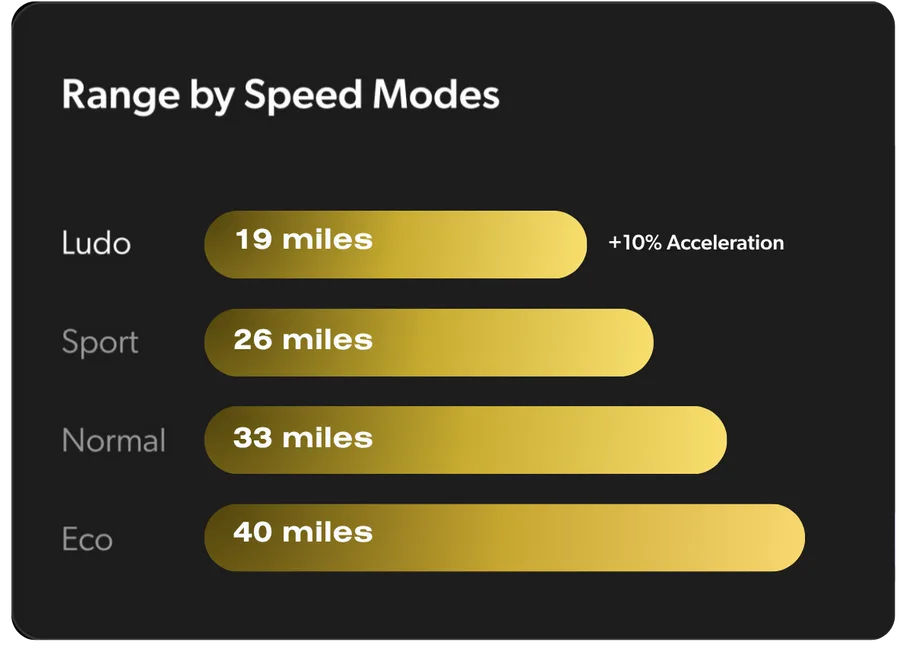
Apollo claims 64 km. We got 48 km on the standard loop in the top mode at 78 kg — a 25% shortfall, which is mid-table. Top speed is a genuine 51 km/h and completely illegal on any public road in the markets Apollo sells to, so treat it as headroom for hills rather than as a commuting setting.
Braking is good: 3.4 m dry from 25 km/h, 4.5 m wet, and almost no measurable fade across ten consecutive stops. The drum brakes need no maintenance and never squealed, which after a wet fortnight is worth noting.
The regen throttle deserves its own paragraph
Apollo puts regenerative braking on a separate left-hand thumb throttle rather than tying it to a lever. You modulate deceleration with your thumb, the same way you modulate acceleration with the other one, and after two days it becomes the only brake you use in traffic. It also recovers up to about 10% of pack charge on a hilly route.
This should be standard. It is not, on anything else at this price.
Thirty-three kilograms
Here is the compromise. The City 2.0 weighs 33 kg. That is not a scooter you take on a train, up a staircase, or into a third-floor flat. It is a scooter that lives in a garage, a bike room or a ground-floor hallway. If none of those exist in your life, stop reading and buy something lighter — the ride quality will not compensate.
Fold is quick and the latch is solid, but the mass sits high when folded
There is no practical carry handle; you drag it on its wheels or you deadlift it
IP66 means you can leave it out in weather, which softens the storage problem
The lighting is better than it needs to be
Turn signals on the deck and stem, a headlight mounted high enough to actually illuminate road surface rather than the kerb in front of you, and brake lights that come on with the regen throttle as well as the levers. It is the most complete lighting package on any kick scooter in this index.
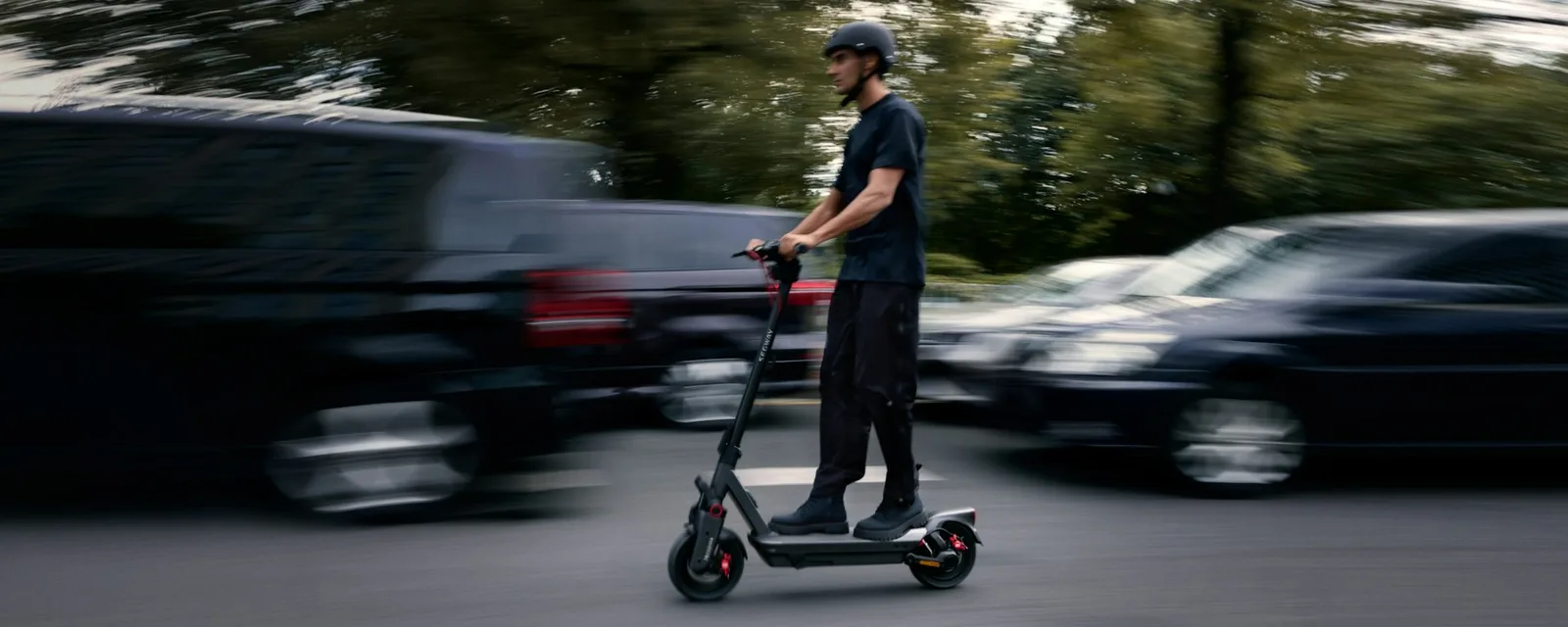
This matters more than the spec sheet implies. The failure mode for a commuter scooter is not the rider losing control; it is a driver not seeing a small, low, quiet object at a junction. Apollo builds this machine like something that expects to share a road with cars, and after a month of dark evening rides we would not go back to a scooter with a single 3 W lamp on the stem.
Four weeks of ordinary use
Nothing needed adjusting. The IP66 rating meant the scooter lived outdoors for the entire month, in rain, without consequence — which is the only reason the 33 kg is survivable, because it never had to come inside.
Charging from empty took a little under seven hours on the standard charger. There is a fast charger available and, as with the Apollo Phantom, it should be in the box at this price rather than on the accessories page.
One genuine annoyance: the app requires a connection to change riding modes, and on a phone with poor signal in an underground car park it occasionally refused. Mode switching should be possible from the physical controls, and it is not.
Where it sits
Against the Apollo City Stellar at $1,499 you get two 900 W motors, 55 km/h and drum brakes with regen — a faster, more capable machine for $200 more. Against the NIU KQi 300X at $899, the Apollo is $400 more for a better ride and worse portability.
We would take the 2.0 over the Stellar for commuting. Dual motors on a city scooter buy you hill speed you rarely need and range you always miss.
Verdict
The City 2.0 is the scooter we reach for when the route is long, the road is bad, and there is somewhere to park it. It loses points for weight and for a range claim that does not survive contact with a real loop, and it is still the most pleasant way to cover 10 km of broken city asphalt standing up.
What works
- Airflow suspension with 20% more travel and rubber rebound damping — the class benchmark
- Turn signals on the deck and stem that drivers actually see
- Regenerative braking on a dedicated left throttle, which is the best implementation we have used
- Frame and folding mechanism feel over-engineered in the good way
What does not
- 33 kg. This is a scooter you park, not a scooter you carry
- 48 km measured against a 64 km claim — a 25% gap
- Priced above the NIU KQi 300X by $400 for a comparable commute
On paper
| Top speed | 51 km/h (32 mph) |
|---|---|
| Claimed range | 64 km (40 mi) |
| Measured range | 48 km |
| Weight | 33 kg (72 lb) |
| Suspension | Airflow, front and rear |
| Water resistance | IP66 |
How the score is built
In the metal
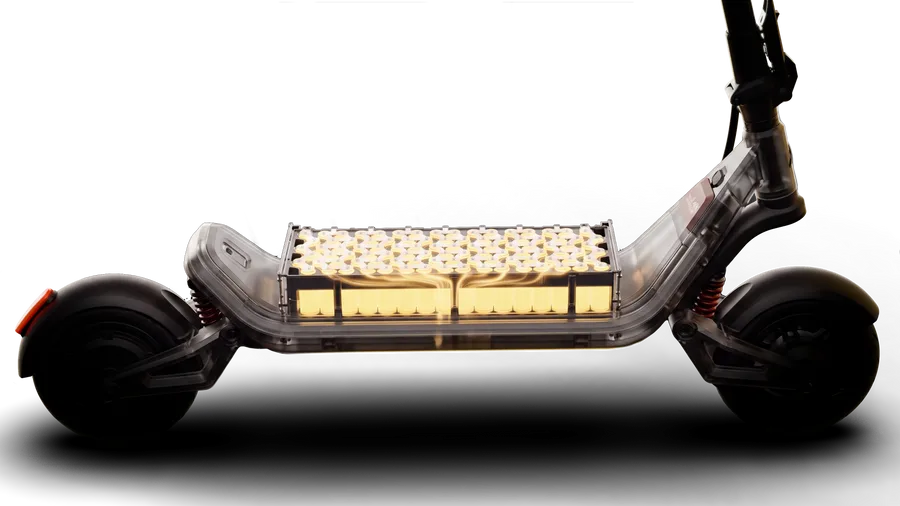
Where the numbers came from
- Manufacturer specification: Apollo Scooters
- Range, braking and charge figures measured by the Duskmile test protocol.
Keep reading
More from City Scooters
 8.7
Segway Ninebot MAX G3 review: the commuter scooter that stopped apologising
Segway put a 597Wh pack, dual suspension and self-healing tubeless tyres on one frame, then asked $1,500 for it. Four weeks later we understand the price — and the one reason to wait.
- From$1,499
- Motor2000 W peak
- Top speed45 km/h (28 mph)
 8.4
NIU KQi 300X: the sensible answer to a question most scooters get wrong
608Wh, hydraulic front suspension and 22 kg. The KQi 300X is not the fastest thing here and does not want to be — it wants to still be working in three years.
- From$899
- Battery608.4 Wh (13 Ah)
- Claimed range60 km (37.3 mi)
 7.4
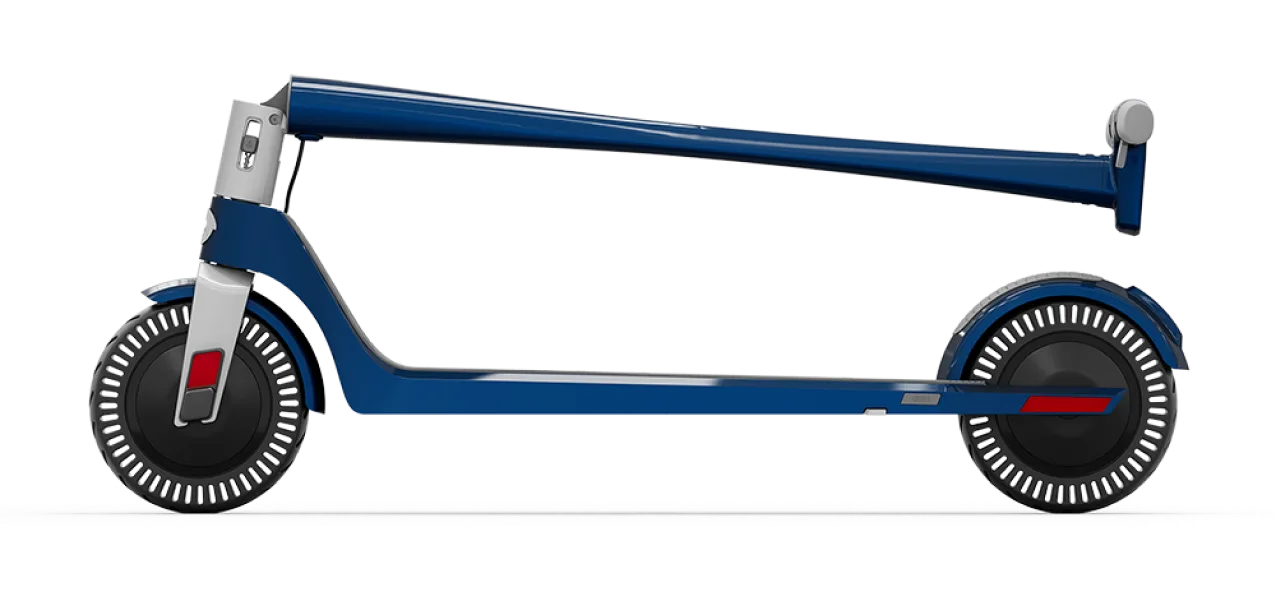
Unagi Model One Voyager: the design object that has to justify itself
Dual motors, a carbon-look frame and a price near $1,200. The Voyager is the only scooter here you would willingly carry — and the numbers make you pay for that.
- From$1,190
- Motors2 × 250 W (1000 W+ peak)
- Battery360 Wh