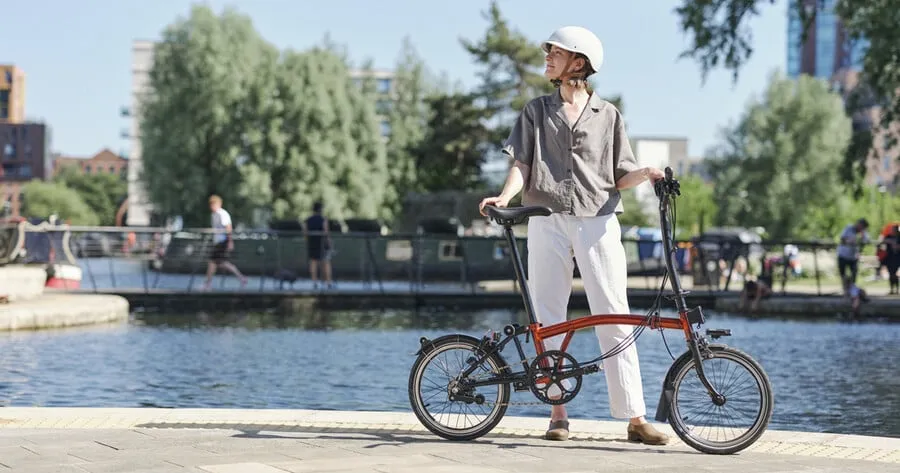
Brompton Electric P Line: $4,700 for a fold, and the fold is worth it
12.7 kg without the battery, a titanium rear triangle, and a fold nothing else comes close to. The P Line is absurdly expensive and we would still buy one.
The verdict
The only genuinely portable electric bike on this list. Everything else that calls itself folding is a bike that gets smaller.
Visit BromptonThere are two kinds of folding electric bike. There is the kind that folds — awkwardly, into a smaller but still large object you put in a car. And there is the Brompton, which becomes luggage.
That distinction is worth about three thousand dollars, and whether it is worth it to you depends on one question: does your journey involve a train?
The fold, measured
Twenty seconds, unhurried, with no tools and no thinking. The result is a package small enough to stand in a train vestibule without blocking it, go through a ticket barrier, and sit under an office desk. At 15.6 kg ride-ready it is carryable up a flight of stairs by one person who is not an athlete.
Take the 300Wh battery off the front carrier block and the bike weighs from 12.7 kg — and is a completely normal, completely good Brompton. That is the other clever part: the electric system is an addition rather than an integration, so you can leave it at home for a flat day and the bike does not become dead weight.
Every other bike here folds. This one becomes something you carry without thinking about it.
What it is like to ride
Quick, light-steering and slightly nervous, which is what 16-inch wheels do. On good asphalt it is delightful. On the sort of patched, ridged, utility-trenched surface that most cities actually have, it is hard work, and every imperfection arrives in your hands.
The 250 W front hub is tuned conservatively and cuts at 25 km/h. There is no mode that goes faster because this is a European-legal pedelec. On a 6 km urban trip that is entirely adequate; the assist makes the hills disappear and the flat sections are yours.
Range
Brompton claims up to 90 km. Our loop in the highest assist at 78 kg gave 54 km. From a 300Wh pack on a bike with small wheels and a front hub, that is a strong result, and it is more than the Cowboy Cruiser managed from a battery of the same size.
The weak point
Braking. Small wheels, a light bike and a lot of rider mass high up combine badly in the wet. We measured 4.8 m dry from 25 km/h and 6.1 m wet — the longest wet figure of any bike in this index. It is manageable if you ride accordingly. It is the one number we would want Brompton to fix.
Living with it for a month
Our test was a genuine multi-modal commute: 3 km ride, 40 minutes of train, 2 km ride at the other end, twice a day for four weeks. That is 40 folds and unfolds a week, and it is the use case the P Line exists for.
Three things emerged. The hinges developed no play at all, which after roughly 160 fold cycles is the strongest possible endorsement of a design Brompton has been refining for decades. The front carrier block that holds the battery is a genuinely good system — the pack comes off in a second and goes into a bag. And the 4-speed gearing is enough: with motor assist, the wider 12-speed range is a luxury rather than a requirement, and the 4-speed is the lighter bike.
The one ongoing irritation is the charger. It is a separate brick with its own cable, and it is bulky enough that carrying it to the office is a decision rather than an afterthought. At four hours for a full charge from the 2 A unit, you will mostly charge at home overnight and accept that.
What the titanium buys
The P Line's rear triangle and fork are titanium, which is most of the difference between this and the heavier C Line. On paper it is about 1.5 kg. In practice it is the difference between a bike you lift onto a train without thinking and one you brace yourself for, and over a twice-daily commute that gap compounds into whether you keep using it.
It also does not corrode. On a bike that lives in rain and gets stood in train vestibules with wet floors, that matters over a decade.
Is $4,700 defensible?
Not on specification. A Lectric XP 4 costs $999, has more power, more range and better brakes, and folds after a fashion. On every measurable axis except weight and fold size, the Lectric wins.
But the measurable axes are not the point. The P Line is the only bike here that fits into a multi-modal commute without negotiation, and it is built — titanium, machined aluminium, decades of iteration on one hinge design — to still be doing that in fifteen years. If your journey needs it, nothing else will do. If it does not, do not spend the money.
What works
- From 12.7 kg (27.9 lb) without the battery pack — carryable by an ordinary person
- Folds to a package you can take on a train, into a lift and under a desk, in about 20 seconds
- Titanium rear triangle and fork are the reason for the weight, and they last
- 300Wh removable front pack leaves the bike a normal Brompton when you take it off
What does not
- $4,700, and the 12-speed costs more than the 4-speed
- 16-inch wheels mean bad road surfaces are genuinely unpleasant
- 250 W and a 25 km/h assist cap — this is a European-legal bike, not a fast one
- Rim-brake heritage and small wheels make wet braking the weakest score here
On paper
| Motor | 250 W brushless DC front hub |
|---|---|
| Assist limit | 25 km/h (15.5 mph) |
| Battery | 300 Wh, 36 V, removable |
| Claimed range | Up to 90 km (56 mi) |
| Measured range | 54 km (high assist) |
| Weight | From 12.7 kg / 15.6 kg ride-ready |
| Charge time | 4 h on the 2 A charger |
How the score is built
In the metal
Where the numbers came from
- Manufacturer specification: Brompton Bicycle
- Range, braking and charge figures measured by the Duskmile test protocol.
Keep reading
More from Folding & Compact
 8.5
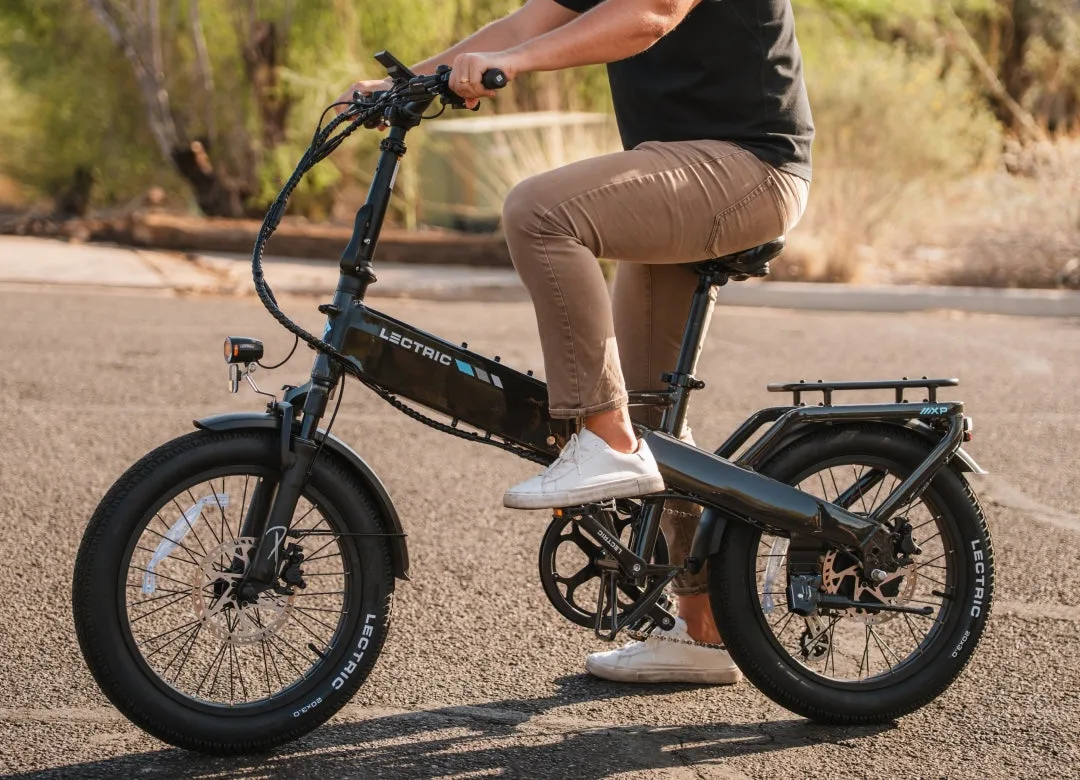
Lectric XP 4 review: a torque sensor and hydraulic brakes for $999
The XP 4 does things at $999 that cost $2,000 two years ago. It also weighs a lot and folds into an awkward lump. Both of those facts matter.
- From$999 (500 W)
- Motor (500 W build)500 W rear hub, 1092 W peak, 55 Nm
- Motor (750 W build)750 W rear hub, 1310 W peak, 85 Nm